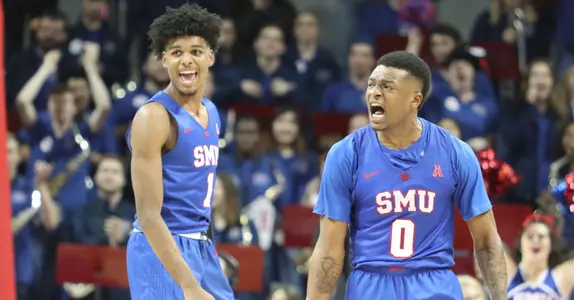
Mustangs' Rebounding Showcases Intensity And Effort
Dec 12 | Men's Basketball
By Andy Lohman
After taking a 10-day break around final exams, SMU men's basketball returns to action on Saturday, Dec. 15 at Georgetown.
The Mustangs and Hoyas have played just once before: in the second round of the 1984 NCAA Tournament. SMU lost a tightly contested game, 37-36, as Georgetown went on to win the NCAA Championship behind the tournament's Most Outstanding Player, Patrick Ewing. Ewing, who won an Olympic gold medal for USA Basketball with SMU's Jon Koncak later that summer, is the head coach of the modern-day Hoyas.
The modern-day Mustangs dropped their last outing against TCU on Dec. 5 after a cold shooting second half, but have won four of their last five and have plenty of positives to take into D.C.
Since senior guard Jarrey Foster returned from injury in a Nov. 27 win over Lamar, SMU has improved in three key areas that will keep the Mustangs competitive in games regardless of shooting form.
1. Ball Movement
Foster's experience within the system and poise on the court is a boost to SMU's offense. The ball has been moving fluidly as the Mustangs work for the best shot. In the six games before Foster's return, SMU averaged 12.5 assists per game as a team. In his first three games back, SMU dished 23 assists against Lamar, 24 against McNeese, and 16 against Oral Roberts. The effect has gone beyond just Foster: senior guard Jahmal McMurray had a career-high nine assists against Lamar and junior guard Jimmy Whitt Jr. had a career-high 10 against McNeese.
2. Offensive Rebounding
SMU is averaging 13.7 offensive rebounds per game, the second-best mark in the American Athletic Conference and the 23rd-best in the NCAA. Four Mustangs (Whitt, Feron Hunt, Ethan Chargois, and Isiaha Mike) rank in the top 15 individually in the AAC in offensive rebounds. SMU has an offensive rebound percentage (the number of offensive rebounds in proportion to the total number of offensive rebounds available) of 39.3 percent, which is the eighth-best mark in the country. Crashing the offensive glass creates second- and third-chance opportunities. Even though the Mustangs shot 24 percent from the floor in the second half against TCU, they were in the game late because they grabbed 20 out of 41 available offensive rebounds, a staggering 48.7 percent.
The second-chance opportunities help win games, but SMU's superior offensive rebounding showcases the drive and effort required from a college basketball team to win at a high level. Offensive rebounds are so hard to get because they take tremendous effort and fight.
"I thought our guys competed great," head coach Tim Jankovich said in the postgame press conference after TCU. "I thought we had tremendous effort, tremendous energy, intensity, focus, attention to detail, I thought [it] was all great."
Freshman Feron Hunt has been particularly aggressive on the boards, grabbing 6.9 rebounds in just 21.3 minutes per game. Jankovich has praised his work ethic, which complements his athleticism and long frame. The rookie is second in the AAC with 3.1 offensive rebounds per game.
3. Defense
In each of the three games before Foster's return, SMU's opponents scored at least 75 points. Since the senior has come back, the Mustangs have held opponents to under 70 points in four straight games. That includes TCU, a team that is receiving votes in both the AP and Coaches polls. The Horned Frogs routed Eastern Michigan 87-69 and Central Michigan 89-62 the week before playing SMU, then two days later dismantled USC 96-61 at the Staples Center in Los Angeles.
"We have to focus on that," Foster said. "The harder we play on defense, the more we'll stop them and get it going on offense."
After taking a 10-day break around final exams, SMU men's basketball returns to action on Saturday, Dec. 15 at Georgetown.
The Mustangs and Hoyas have played just once before: in the second round of the 1984 NCAA Tournament. SMU lost a tightly contested game, 37-36, as Georgetown went on to win the NCAA Championship behind the tournament's Most Outstanding Player, Patrick Ewing. Ewing, who won an Olympic gold medal for USA Basketball with SMU's Jon Koncak later that summer, is the head coach of the modern-day Hoyas.
The modern-day Mustangs dropped their last outing against TCU on Dec. 5 after a cold shooting second half, but have won four of their last five and have plenty of positives to take into D.C.
Since senior guard Jarrey Foster returned from injury in a Nov. 27 win over Lamar, SMU has improved in three key areas that will keep the Mustangs competitive in games regardless of shooting form.
1. Ball Movement
Foster's experience within the system and poise on the court is a boost to SMU's offense. The ball has been moving fluidly as the Mustangs work for the best shot. In the six games before Foster's return, SMU averaged 12.5 assists per game as a team. In his first three games back, SMU dished 23 assists against Lamar, 24 against McNeese, and 16 against Oral Roberts. The effect has gone beyond just Foster: senior guard Jahmal McMurray had a career-high nine assists against Lamar and junior guard Jimmy Whitt Jr. had a career-high 10 against McNeese.
2. Offensive Rebounding
SMU is averaging 13.7 offensive rebounds per game, the second-best mark in the American Athletic Conference and the 23rd-best in the NCAA. Four Mustangs (Whitt, Feron Hunt, Ethan Chargois, and Isiaha Mike) rank in the top 15 individually in the AAC in offensive rebounds. SMU has an offensive rebound percentage (the number of offensive rebounds in proportion to the total number of offensive rebounds available) of 39.3 percent, which is the eighth-best mark in the country. Crashing the offensive glass creates second- and third-chance opportunities. Even though the Mustangs shot 24 percent from the floor in the second half against TCU, they were in the game late because they grabbed 20 out of 41 available offensive rebounds, a staggering 48.7 percent.
The second-chance opportunities help win games, but SMU's superior offensive rebounding showcases the drive and effort required from a college basketball team to win at a high level. Offensive rebounds are so hard to get because they take tremendous effort and fight.
"I thought our guys competed great," head coach Tim Jankovich said in the postgame press conference after TCU. "I thought we had tremendous effort, tremendous energy, intensity, focus, attention to detail, I thought [it] was all great."
Freshman Feron Hunt has been particularly aggressive on the boards, grabbing 6.9 rebounds in just 21.3 minutes per game. Jankovich has praised his work ethic, which complements his athleticism and long frame. The rookie is second in the AAC with 3.1 offensive rebounds per game.
3. Defense
In each of the three games before Foster's return, SMU's opponents scored at least 75 points. Since the senior has come back, the Mustangs have held opponents to under 70 points in four straight games. That includes TCU, a team that is receiving votes in both the AP and Coaches polls. The Horned Frogs routed Eastern Michigan 87-69 and Central Michigan 89-62 the week before playing SMU, then two days later dismantled USC 96-61 at the Staples Center in Los Angeles.
"We have to focus on that," Foster said. "The harder we play on defense, the more we'll stop them and get it going on offense."


Players Mentioned

Forward
/ Men's Basketball
Guard
/ Men's Basketball
Forward
/ Men's Basketball
Guard
/ Men's Basketball
Forward
/ Men's Basketball
Guard
/ Men's BasketballThursday, October 08
Thursday, October 08
Thursday, October 08
Wednesday, October 07