Nov 19 | Men's Basketball, Women's Basketball
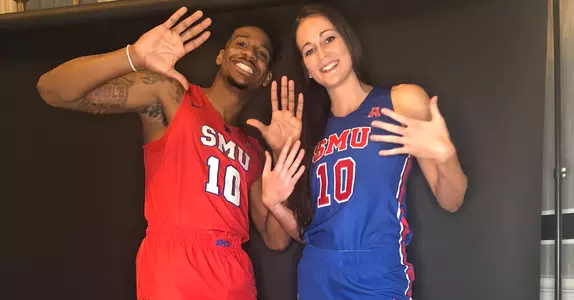
Jarrey Foster and Alicia Froling both wear the number 10, but their similarities don't end there. Adversity struck the pair, the respective leaders of SMU men's and women's basketball, last year when they each tore an ACL in the midst of promising seasons. Rehabbing can be difficult, but fortunately, Foster and Froling were there to support each other through the process. The two seniors recently sat down with SMUMustangs.com to discuss their friendship, rehab and mental health. (The following transcript has been lightly edited for clarity).
How difficult is it to face an injury and miss playing time as an upperclassman?
Alicia Froling: "I think for me the biggest thing was that it was my senior year. So I had everything planned out, which I realize now was a mistake because you can't plan the future. But it happened two weeks before the first game. Originally, everybody thought it was an injury I'd be back for in time, but I had experience with it because my sister went through the same thing. I was like, 'I'm done.' And I remember telling everybody that, and everybody was trying to be positive with me. I was like, 'No, I'm done.' So I think emotionally I was really distraught. Everybody thought it was because I was missing a few games, but it was because I knew the magnitude of it. Me and Jarrey were actually talking the other day, because I was moping around here for about two weeks I was just so upset, and he doesn't even remember it, but he came up because he had his ACL previous to this one and was like, 'Yo, you've got it. You've got to get out of this funk.' I just needed somebody to snap me out of it because I was, I was just walking around here really upset. Everything that I saw in the future, it wiped it clean off and it took me awhile to adjust to that."
Jarrey Foster: "Well the same thing was for me, like she said, planning out everything that was going to happen after the year. Last year, going into my junior year, I really was not thinking about the NBA or anything like that, but as I started to play and play well I started to hear and get more feel that I possibly could have been a draft pick. The way the year was going, and me being one of the leaders on the team and for me to have that kind of injury at that time, with everything going so well, it's kind of like getting hit by a bus or something. It's just out of nowhere. And now you have to find a way, what's your plan from here? You have everything, all your dreams and ambitions, and this being my second ACL it was pretty frightening. Because you don't know how you're going to come back from it, are you ever going to reach your dream? Are you ever going to reach where you want to go? And I was so close. That was really the hardest part for me, being one of the older guys and being at the level I was playing at, I was just really scared that I wasn't going to ever reach my dream. But now that I went through the rehab process, I've seen that you can grow and mature in so many more different ways and you can be in a position that you want to be in, you just have to ride the wave."
You both mentioned plans that you had, how did you each refocus your plans?
AF: "I think it was kind of hard for me, because obviously it was my senior year and I didn't honestly know if I wanted to come back for a fifth year. Obviously, we graduated a lot of our class and we're a super young team. I hadn't even played with any of the girls on this team right now. It was a decision whether I wanted to, because my dream is the WNBA, and I knew coming off that injury I wasn't going to be ready for the draft and I wasn't going to be ready for the season, so do I want to sacrifice that? I could go play pro in Australia or I could go play pro in Europe. And then it was making that decision, the coaching staff really helped me, I hadn't probably made a firm decision until around Christmas time when I saw my parents. They came over when my little brother came on his recruiting visit and we spoke about it then. I was like, 'You know what, I've given so much that I need to finish it.' I think my first two years here weren't really what I wanted them to be and I didn't want to end on such a negative note too. So that's what played into it. And I think we have a super bright future, we're changing the culture, so I wanted to be a part of that."
JF: "It's pretty crazy how identical our stories are with the dreams and ambitions I had to play in the NBA. I did enter my name into the NBA Draft without an agent and that whole process was really a learning process. I learned from it, I saw different things that I'm going to have to go through this year now that I'm going to be done with school. But at the same time, it was a very, very stressful process for me just off the fact that I was so different from everybody else that was in the draft. I had so many more different precautions that I had to prepare for. So many different people, you have to know who's in your circle and who's not. You're focusing on all of this while you're trying to make the right decision on whether you should stay in school or go to the NBA and what's the best decision for your career. The best decision for me, it came down to my values. My values were I wanted to finish school, I wanted to get my degree for myself, for my future family and for my family back at home, that was the one thing I did come here for. And also I felt comfortable with the training staff we had here and the coaching staff we had here and the help that I would have around here. All the support I would have coming off the injury, I had the people around me that were going to help me get back to where I wanted to get. Knowing those things and having the support helped my decision and made it a lot easier. Sitting here now, if I had went to the NBA last year while being injured, who knows what could have happened. But now I have the opportunity to fall back on my degree if anything ever happens, and also I've learned so much more. I have the opportunity to lead this team. It's in my hands. I have the opportunity to make this the best it can be."
As you guys are moving back towards being back in playing shape, what has that recovery process been like both physically and mentally?
AF: "It was really tough for me. I think my injury was a little bit different to Jarrey's. I got injured probably three months before you? But we started at almost the same time point because I couldn't walk for almost three months. Mentally doing that, because I'm somebody that's always moving and I'm a very independent person, having to ask somebody, 'Hey, can you carry this?' That was really tough for me. Having to do that for so long, too. It wasn't a week, it was three months where I couldn't even get my food from the kitchen to the table."
JF: "That's the hardest."
AF: "Because you're just taken so far back where I have no control. I think mentally that was the hardest thing. And then watching, obviously our team didn't have a great year last year, so I think that was really hard because I'm such a competitive person. Just to be associated with that and thinking how it would be different if I was out there. And then coming off the success we had the previous year, my junior year, I think just mentally watching the game was tough. But I think looking back, I'm a completely different person because I went through so much stuff and I saw things from a different point of view from when you're just playing. It's so tough in the moment, mentally, physically. Your body can't do things that you can usually do with ease. But looking back, I think it's made me a better person on and off the court."
JF: "The thing for me was, physically, I knew I was going to get back. I've had an ACL before and I've played at one of the highest levels in college basketball, so the physical part wasn't hard for me. I knew every day that I came in here I had to work, that's the bottom line. That's the only way you're going to get better and get to where you want to go, which is the NBA. Physically, I knew I could do that, but it was the mental part, the mental conditioning that I needed that I had to go through. Mentally, every day waking up and not knowing what's to come. Some days it was just blurred, some days it felt like it was raining outside, some days were dark, some days were light. It was all over the place. Some days it just seems like every day is just going back-to-back-to-back and you can't really think about what you want to, then you have to do this and do that. So many different things are coming your way, but you have to learn how to slow it down. And you really have to find out what's important to you at that moment. There were different parts of my rehab where I had to focus in on school, or I had to focus in on rehab. I really had time to myself to really figure out what are the best things for me. Working hard, that's not the problem because that's what we do. Going through injury, being so much different than everybody else, like she said not being able to go get your own food, not being able to walk here, not being able to go out with friends, not being able to do fun things or just be a normal person because you realize you can't be standing on your leg, those little things really get at you. But you have to find a way to stay happy and find a way to have a fellowship with somebody. And that's how this kind of started, we kind of fell into it. We attracted to each other off the fact that we have the same mindset. Obviously we have the same number, but we were going through the same thing. When people go through the same thing, all you can do is help each other. We just helped each other mentally and just tried to keep pushing."
AF: "I think the biggest thing is injuries like this are so isolating because you're not on the court with your team. You're in here [training room] and you're taken away from everything you love to do. Obviously I didn't want that for him and nobody did. But it started off the 10 Curse. That's what [Associate Athletic Trainer] Warren [Young] said since both 10s were out. But he also said, 'Now you're rehab buddies.'"
JF: "It turned a negative into a positive that quickly. That's all an injury is: turning a negative straight into a positive. That's the only way you're going to get through, because as long as you dwell on the negatives that's how your process is going to go. As long as you change your mindset to being positive and trying to better yourself somehow every day, that's what I woke up and told myself every day. Wake up and make sure when you come home, you better know that you got better somehow. You learned something, you did something, you helped somebody else, you got stronger in the weight room. You've just got to know that you got one percent better, and every day you take that home it builds for the next day. It gives you light, and we passed that to each other. Trying to make sure we stayed on top of it because we think so highly of each other. We're both leaders on our teams and a lot of people look up to us. As long as we stay on top of each other and make sure we're working the hardest, the sky is the limit for us. And I don't see anything that's going to stop us, unless it's another injury and we'll bounce back from that again."
How has your friendship grown throughout this process?
[both laugh]
JF: "I mean it's grown pretty much. When I first got here –"
AF: "I mean we would talk, but it was more like, 'Hey, how are you doing?'"
JF: "Acquaintances."
AF: "Obviously like Jarrey said, you have to stay positive and positive, that's how you have to do it. But in the moment when it's such a long injury, it's so hard to stay positive."
JF: "Exactly."
AF: "But just having that, like he would see me down and he would be like 'yo, are you good?' Just to have somebody have your back to reinforce that because even somebody who has gone through a knee injury, they're not going through it at that exact time. I think there's a difference where we knew exactly how each other was feeling. But yeah, its grown."
JF: "It was just friends, but now I know I got her back, she's got my back, I go talk to her whenever I need to and just vent a little bit because I know she understands exactly where I'm coming from. It's no judgement to anybody else, but I just try to keep people close that understand what's really going on. That can really help you because as much as you want to try to be Superman and be Ironman through the situation, it's really tough. You can't always walk around with your chest out. But you've got people out there that look out for you like Alicia. Now every day we walk through here, we give each other high fives and say '10.' It's just a reinforcement that it's time to go to work. It's turned into something that I look forward to every day."
AF: "And I've had teammates comment, you and Jarrey are real with each other, and it's genuine. People can see that too, that I've got your back, you've got my back and I think people see that and acknowledge it because we went through this process together, and it sucked, but I think we've come out on the other side and it's made us so much better."
SMU SAAC is partnering with The American SAAC in its POW6RFUL MINDS initiative to promote mental health. What does "powerful minds" mean to you?
JF: "Powerful minds, once you dig into the mind a little bit and realize the power of the mind, once you figure out how much your mind controls everything, you can switch your mindset that quickly, no matter what the situation is. You have a decision every day whether to do this or do that. It's that easy. And going through this, I realized that all of this had nothing to do with physical pain, physical anything. It was all mental. It's how much can you push yourself. In everything that I did, from the beginning, the first month of surgery, nothing was physical. I had to do no rehab, it was all about just icing and doing small things that you don't usually think about. When you tie into your mind and realize how much that controls your wellbeing, it kind of brings some emotion to your heart to realize there are a lot more people, student-athletes that go through so much on a daily basis. Whether it's depression, anxiety, issues back home, the small things like that that we don't really think of. That's why we partnered with SAAC and the conference to do this, because it's so important to bring awareness to this because there's so many people that don't want to speak out, that can't speak out, that don't have the resources to speak out. Fortunately here at SMU, there are so many people that are here to support you. By doing this, it helps me to keep pushing and helps me to get a voice from everybody else and somehow bring this all together and make sure nobody is left alone."
AF: "I think as athletes, we're expected to be tough, we're expected to be this thing that people hold so highly. But then people also fail to realize that we go through stuff that mentally we really struggle with. I think it's hard for athletes, because we have certain characteristics, it's hard to speak out and go 'I'm struggling right now.' So I think if we bring awareness to it…I hate talking about my feelings, I hate talking about if I'm struggling, but that's where we would always check on each other because we know we've got each other's backs. But it's kind of what this stuff is doing to, where it's bringing awareness that it's okay to speak out. It doesn't matter if you're the star of the basketball team. That's the biggest thing, it's okay to speak out and just because you're a leader at the university who looks like they've got everything going for them, doesn't mean you don't also have problems that you can speak out about."
JF: "I feel like us being leaders, it was important to us to be a part of that because if others see the pedestal we're on playing college basketball and being the leaders on our team, if other student-athletes and other students period, if other people see that we're doing that, that'll give them the light to do it also. It'll make them feel that much more comfortable because they realize people look at us every day, whether it's on TV or in practice or on film, whatever it is we're always getting looked at around campus and we know that that light is shining on us. But for us to talk about things that aren't really focused on that much, that gives others the confidence to help themselves and to speak out also. We're doing what we can and making sure we're in the best position to help others. That's why this built; this number 10 thing built because we're always trying to look out for each other. We don't want anybody else to fall down as long as we're here."

Players Mentioned

Guard
/ Men's Basketball
Forward
/ Women's BasketballSMU Football: Media Availability - Rhett Lashlee and Kevin Jennings 11-24-26
Tuesday, November 24
SMU Men's Soccer Game Highlights vs Bryant 11-22-2026
Monday, November 23
SMU Men's Soccer Post Game Press Conference vs Bryant 11-22-2026
Monday, November 23
SMU Volleyball Match Highlights vs. Virginia 11-22-26
Sunday, November 22