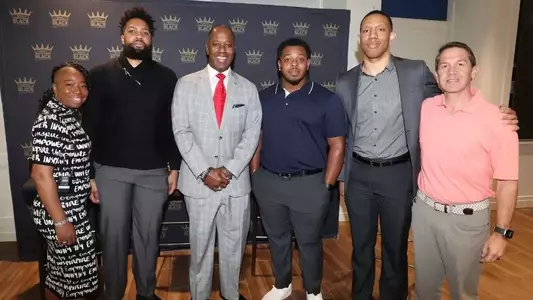
Black Excellence Brunch Panelists Reflecting On Personal Successes
Mar 6 | Football, Men's Tennis, Student-Athlete Success, Lettermen's Association
Finding My Identity by Robert Seals | A Different Path by Daniel Gresham | Against All Odds by Avery Pennywell | Refusing To Be Average by Harvey Armstrong
DALLAS (SMU) - For most NCAA Division I student-athletes, identity can be a hard concept to define.
At this year's annual Black Excellence Brunch, an event hosted by SMU Athletics to celebrate former student-athletes and current Black community members, former SMU fullback and panelist Daniel Gresham '18 said that many student-athletes - especially Black student-athletes -don't begin to question their identity or sense of purpose until after they're forced to leave their sport.
In his second year at SMU, Gresham was confronted with a decision after suffering a neck injury. He could retire from the sport or risk losing functionality in his right arm if he was hit the wrong way. He opted to retire, but in doing so, was forced into figuring out what he wanted to do with his life after dedicating his childhood to football.
"Your sport is your identity," Gresham said. "The number one goal is to get your family out of poverty, and the only way that you know how to do that is through your physical attributes. But for me, (my injury) was a blessing in disguise because a lot of people don't come to that decision until they're forced to walk away from the game, and usually they're out of school."
After dabbling in software development and entrepreneurship with fellow panelist Robert Seals '15, Gresham's close friend, NFL wide receiver and SMU alum Courtland Sutton contacted him for help navigating the professional sports world. From that experience, Gresham learned that 78% of NFL players go broke or bankrupt two-to-three years after retirement. To help curb this problem, Gresham created Fortify Management, a firm dedicated to helping professional athletes build long-term equity and stability.
"Being so close to so many people in the athletics space who had an opportunity to touch a decent amount of money and then lost it was something that truly kept me up at night," Gresham said. "It was hard for it not to be a passion for me."
Panelist and former SMU and Philadelphia Eagles defensive lineman Harvey Armstrong '82 was also forced to grapple with his identity at a later age. After spending eight years playing professionally, Armstrong felt lost. Football had ended for him, even though he still wanted to play (and still does 33 years later! His knees might not be all they used to be, but he can still put his hand on the line!).
When he felt distraught transitioning from the NFL to the "real world," Armstrong said that his mother kept him motivated. When he was cut by the Eagles, it was his mother that encouraged him to keep training so that he could continue playing in the NFL, and it was the memory of his mother that later kept him driven to continue growing as a person after his football career.
"That was my motivation, knowing that my mother would be so disappointed in me if I didn't succeed," Armstrong said. "Even at 64-years-old, I still can hear her voice telling me to be the best that you can be. I'm trying to be the best father, the best is husband, the best teammate and the best person."
After leaving the NFL, Armstrong began using his marketing degree to create and operate football camps, start a nonprofit and work in insurance with his wife, Sharon.
Although, again, Armstrong would have played football forever if he could, he believes that it is important for everyone, including his daughter, Sidney, to have a Plan B. He regrets originally putting all his eggs in the football basket and believes that having multiple interests and passions is healthy.
"What I want to tell people here is that it is okay to put your whole heart and your passion and your work and your love into (something), whether it's football, basketball, track or academics," Armstrong said. "But what's Plan B? It's okay to have Plan B. You should work your tail off to get to Plan A, but Plan B can be reality. And I never had a Plan B."
In recent years, SMU has been very intentional in better preparing its student-athletes for considering their Plan B's and confronting their identity. When Seals was on the Hilltop, he didn't consider himself to be "the best student." At one point, he was assigned to Life After Ball (LAB) Director Lisa Rawlins after he received 27 "academic strikes" in a semester, when he was supposed to keep the infractions under three.
After discovering that Seals was working harder to calculate how many absences and missing assignments he could have to still pass his classes, Rawlins worked with Seals weekly to get him academically-engaged at SMU. He eventually discovered his love for creating and received his first "A" in a computer animation class.
"I was the first man in my family to graduate college," Seals said. "To go through that process and experience that this is how I found my passion."
Former tennis player and recent graduate Avery Pennywell '22 encourages current Black student-athletes to take full advantage of the resources available at SMU. In addition to playing tennis, Pennywell had a full-ride academic scholarship and double majored in biology and finance so that he could try out pre-med but also have a reliable fallback if he struggled or had disinterest in the coursework.
Pennywell said that SMU did a good job at allowing him the space to explore different interests and find unique ways to bridge them together, both through its departmental support and network-heavy culture.
"I feel like SMU emphasizes it isn't always what you know, but who you know," Pennywell said. "Being able to bridge together two different fields and integrating that into something special or something new is really good."
The Black Excellence Brunch reinforced Pennywell's emphasis on networking and taking advantage of SMU's resources. It is a "first-class" celebratory and networking event, where students were able to interact with several Black SMU officials including Student Affairs Diversity Officer Dr. Jennifer "JJ" Jones, Vice President of Student Affairs Dr. K.C. Mmeje, Chief Diversity Officer Dr. Maria Dixon-Hall, and SMU Athletics' Director of Inclusive Excellence Brenda Scott.
"My goal (for this annual event) is to get 100 student-athletes here, continue to build the alumni base, and keep bringing in our Black faculty, staff and students to see the excellence of our student-athletes," Scott said. "At the end of the day, our student-athletes are students first and we are all here to build them up and position them for future success."
DALLAS (SMU) - For most NCAA Division I student-athletes, identity can be a hard concept to define.
At this year's annual Black Excellence Brunch, an event hosted by SMU Athletics to celebrate former student-athletes and current Black community members, former SMU fullback and panelist Daniel Gresham '18 said that many student-athletes - especially Black student-athletes -don't begin to question their identity or sense of purpose until after they're forced to leave their sport.
In his second year at SMU, Gresham was confronted with a decision after suffering a neck injury. He could retire from the sport or risk losing functionality in his right arm if he was hit the wrong way. He opted to retire, but in doing so, was forced into figuring out what he wanted to do with his life after dedicating his childhood to football.
"Your sport is your identity," Gresham said. "The number one goal is to get your family out of poverty, and the only way that you know how to do that is through your physical attributes. But for me, (my injury) was a blessing in disguise because a lot of people don't come to that decision until they're forced to walk away from the game, and usually they're out of school."
After dabbling in software development and entrepreneurship with fellow panelist Robert Seals '15, Gresham's close friend, NFL wide receiver and SMU alum Courtland Sutton contacted him for help navigating the professional sports world. From that experience, Gresham learned that 78% of NFL players go broke or bankrupt two-to-three years after retirement. To help curb this problem, Gresham created Fortify Management, a firm dedicated to helping professional athletes build long-term equity and stability.
"Being so close to so many people in the athletics space who had an opportunity to touch a decent amount of money and then lost it was something that truly kept me up at night," Gresham said. "It was hard for it not to be a passion for me."
Panelist and former SMU and Philadelphia Eagles defensive lineman Harvey Armstrong '82 was also forced to grapple with his identity at a later age. After spending eight years playing professionally, Armstrong felt lost. Football had ended for him, even though he still wanted to play (and still does 33 years later! His knees might not be all they used to be, but he can still put his hand on the line!).
When he felt distraught transitioning from the NFL to the "real world," Armstrong said that his mother kept him motivated. When he was cut by the Eagles, it was his mother that encouraged him to keep training so that he could continue playing in the NFL, and it was the memory of his mother that later kept him driven to continue growing as a person after his football career.
"That was my motivation, knowing that my mother would be so disappointed in me if I didn't succeed," Armstrong said. "Even at 64-years-old, I still can hear her voice telling me to be the best that you can be. I'm trying to be the best father, the best is husband, the best teammate and the best person."
After leaving the NFL, Armstrong began using his marketing degree to create and operate football camps, start a nonprofit and work in insurance with his wife, Sharon.
Although, again, Armstrong would have played football forever if he could, he believes that it is important for everyone, including his daughter, Sidney, to have a Plan B. He regrets originally putting all his eggs in the football basket and believes that having multiple interests and passions is healthy.
"What I want to tell people here is that it is okay to put your whole heart and your passion and your work and your love into (something), whether it's football, basketball, track or academics," Armstrong said. "But what's Plan B? It's okay to have Plan B. You should work your tail off to get to Plan A, but Plan B can be reality. And I never had a Plan B."
In recent years, SMU has been very intentional in better preparing its student-athletes for considering their Plan B's and confronting their identity. When Seals was on the Hilltop, he didn't consider himself to be "the best student." At one point, he was assigned to Life After Ball (LAB) Director Lisa Rawlins after he received 27 "academic strikes" in a semester, when he was supposed to keep the infractions under three.
After discovering that Seals was working harder to calculate how many absences and missing assignments he could have to still pass his classes, Rawlins worked with Seals weekly to get him academically-engaged at SMU. He eventually discovered his love for creating and received his first "A" in a computer animation class.
"I was the first man in my family to graduate college," Seals said. "To go through that process and experience that this is how I found my passion."
Former tennis player and recent graduate Avery Pennywell '22 encourages current Black student-athletes to take full advantage of the resources available at SMU. In addition to playing tennis, Pennywell had a full-ride academic scholarship and double majored in biology and finance so that he could try out pre-med but also have a reliable fallback if he struggled or had disinterest in the coursework.
Pennywell said that SMU did a good job at allowing him the space to explore different interests and find unique ways to bridge them together, both through its departmental support and network-heavy culture.
"I feel like SMU emphasizes it isn't always what you know, but who you know," Pennywell said. "Being able to bridge together two different fields and integrating that into something special or something new is really good."
The Black Excellence Brunch reinforced Pennywell's emphasis on networking and taking advantage of SMU's resources. It is a "first-class" celebratory and networking event, where students were able to interact with several Black SMU officials including Student Affairs Diversity Officer Dr. Jennifer "JJ" Jones, Vice President of Student Affairs Dr. K.C. Mmeje, Chief Diversity Officer Dr. Maria Dixon-Hall, and SMU Athletics' Director of Inclusive Excellence Brenda Scott.
"My goal (for this annual event) is to get 100 student-athletes here, continue to build the alumni base, and keep bringing in our Black faculty, staff and students to see the excellence of our student-athletes," Scott said. "At the end of the day, our student-athletes are students first and we are all here to build them up and position them for future success."
Saturday, October 17
Saturday, October 17
Saturday, October 17
Thursday, October 15